
 Fullscreen
With the upgraded mid-mounted 5.2-liter V10 now producing up to 612 horsepower and 428 lb-ft of torque, the facelifted R8 now rockets from 0-60 in a mere 3.1 seconds, accompanied by a thrilling soundtrack
by MotorheadOne on May 24, 2024, 10:30The Audi R8 is a two-seater, mid-engine sports car that continues turning heads since its initial debut in 2006. Now in its second generation, launched in 2015, the R8 shares its platform and engine with the Lamborghini Huracán. Available exclusively with the V10 engine, it’s now capable of producing up to 612 horsepower.
For 2019, it receives a significant refresh that includes updated styling, more powerful engines, and new technology features. The base V10 now makes 562 hp (up from 532 hp), while the V10 Performance jumps to 612 hp (from 602 hp). Audi claims a 0-60 mph time as quick as 3.1 seconds and a top speed of 205 mph.
The R8 competes against other high-end sports cars like the Porsche 911 Turbo, Mercedes-AMG GT R, Acura NSX, and McLaren 570S. With a starting price of around $170,000, it’s one of the more expensive options in its class. However, the R8’s impressive performance, advanced technology, and everyday usability help justify its premium positioning.
Does this refreshed second-generation model have what it takes to stand out in the increasingly competitive exotic sports car segment? Let’s see if the latest updates help keep the R8 at the top of its game.
What’s new?

Visually, the R8 gets a revised front fascia with a wider, flatter Singleframe grille and a new front lip spoiler. The air intakes are reshaped, and there are now three slits above the grille as a nod to the classic Audi Sport. At the rear, a new diffuser is flanked by large oval exhaust tips.
Inside, the R8 gains Audi’s latest MMI infotainment system with navigation and a 12.3-inch digital instrument cluster. Wireless phone charging and an integrated 4G LTE Wi-Fi hotspot are now standard. The steering wheel, shift paddles, and trim pieces have also been redesigned.
The biggest news is under the hood, where the 5.2-liter V10 engine receives a power boost. The standard R8 now makes 562 horsepower and 406 lb-ft of torque, up from 532 hp and 398 lb-ft previously. The V10 Performance model (replacing the old V10 Plus) is even more potent, with 612 hp and 428 lb-ft - increases of 10 hp and 15 lb-ft. A new particulate filter helps reduce emissions and meet stricter regulations.
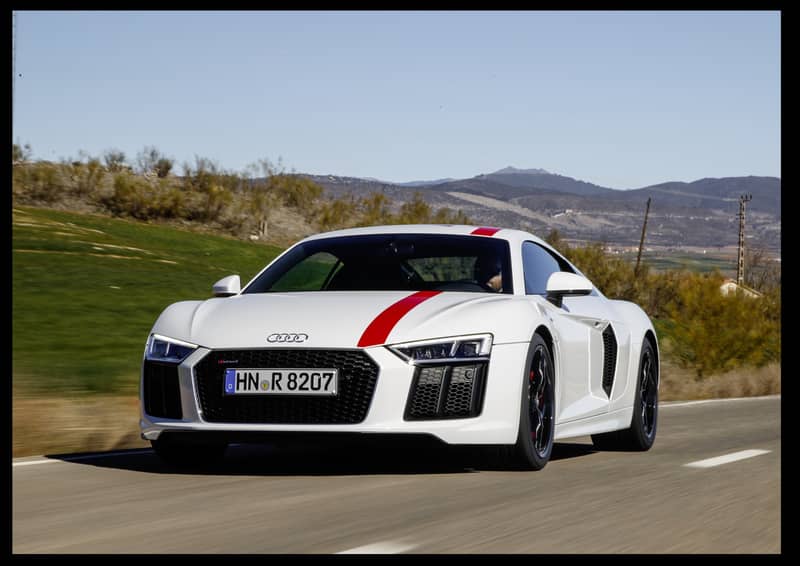
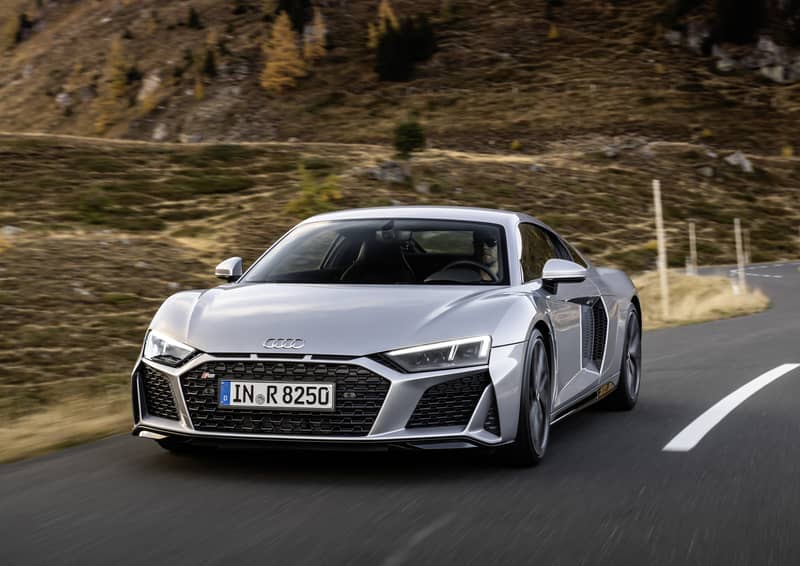
The iconic design gets an aggressive makeover
The 2019 R8’s exterior styling is an evolution of the previous model, with sharper lines and more aggressive details. The front end is dominated by a large hexagonal grille with a gloss black insert. Angular LED headlights flank the grille, while prominent air intakes feed the front brakes and radiators.
In profile, it maintains its distinctive sideblade intakes aft of the doors, which can now be customized with different colors and finishes. The sloping roofline flows into a rounded rear deck with an integrated spoiler. LED taillights span the full width of the car, and a new rear diffuser houses large oval exhaust outlets.
Nineteen-inch wheels are standard, with 20-inch designs optional. A sports exhaust system with gloss black tips is also available. Overall dimensions are nearly identical to those of the outgoing R8: 174.4 inches long, 76.4 inches wide, and 48.8 inches high. The wheelbase remains 104.3 inches.


2019 Audi R8 exterior dimensions
| Specifications | 2019 Audi R8 Coupe (Second-gen) | 2007 Audi R8 Coupe (First-gen) |
|---|---|---|
| Length | 4,426 mm | 4,431 mm |
| Width | 2,037 mm | 2,029 mm |
| Height | 1,240 mm | 1,252 mm |
| Wheelbase | 2,650 mm | 2,650 mm |
The naturally aspirated V10 gets a power upgrade
The heart of the R8 is its naturally aspirated 5.2-liter V10 engine. In standard tune, it produces 562 horsepower and 406 lb-ft of torque. Upgrading to the Performance model boosts output to 612 hp and 428 lb-ft. Both versions have a sky-high 8,500 rpm redline and a spine-tingling exhaust note.
The only gearbox offered is a seven-speed dual-clutch automatic transmission. It provides lightning-quick shifts and can be operated manually via steering wheel paddles. Audi’s quattro all-wheel drive system is standard, with a default 30/70 front/rear torque split. The system can send up to 100% of available torque to either axle as needed.
The V10 Performance adds a few go-fast goodies, including a sports exhaust system, a carbon fiber front sway bar, and a performance mode for the stability control system. It also gets a carbon fiber engine cover and rear diffuser.
Despite its high-performance calibration, the R8’s V10 is surprisingly docile in everyday driving. The auto stop/start system is smooth, and the cylinder deactivation feature imperceptibly shuts down half the engine under light loads to save fuel. Of course, great power comes with great thirst - the R8 is rated at just 13/20 mpg city/highway. However, if you feel that a 2-door coupe isn’t right for you, you can always consider this option from Audi.
| Specifications | 2019 Audi R8 Coupe | 2019 Audi R8 Performance |
|---|---|---|
| Engine type | V10 | V10 |
| Displacement | 5,204 cc | 5,204 cc |
| Power | 562 hp | 612 hp |
| Torque | 406 lb-ft | 428 lb-ft |
| Top speed | 199 mph | 205 mph |
| 0-60 mph | 3.3 seconds | 3.1 seconds |
| Curb weight | 3,516 lbs | 3,516 lbs |
A driver-focused cabin with premium comfort
The R8’s cockpit is designed with the driver in mind. A flat-bottom steering wheel puts all key controls within easy reach, including the engine start button and Audi Drive Select toggle. The 12.3-inch Virtual Cockpit display handles instrumentation and infotainment duties, eliminating the need for a separate center screen. This helps create a clean, uncluttered dash layout.
High-quality materials abound, with Nappa leather upholstery and trim standard on all models. Alcantara and carbon fiber accents are optional. The power sport seats are comfortable and supportive, with 18-way adjustment and pneumatic bolsters. However, some drivers may find the low seating position and high door sills challenging for entry and exit.
While the R8 is technically a two-seater, there is a small storage shelf behind the seats that can accommodate a pair of small duffel bags. The front trunk offers just 4.0 cubic feet of cargo space - enough for a couple of soft-sided overnight bags.
Standard technology features include MMI Navigation, Apple CarPlay, Android Auto, HD Radio, and a 13-speaker Bang & Olufsen audio system. Driver aids are limited to a rearview camera, front and rear parking sensors, and automatic high beams. More advanced safety tech like adaptive cruise control and lane keeping assist are unavailable.
What’s it like to drive?
As expected, the Audi R8 delivers blistering acceleration and razor-sharp handling. The V10 pulls strongly from any rpm, with a linear power delivery that builds to a screaming crescendo near the redline. The dual-clutch transmission is equally impressive, serving up instantaneous shifts in both automatic and manual modes.
The R8’s chassis is a willing partner in the pursuit of speed. With its mid-engine layout and rear-biased all-wheel drive, the car feels balanced and planted through corners. The steering is quick and precise if a bit lacking in road feel. Carbon ceramic brakes are available for fade-free stopping power on the track.
Despite its performance, the R8 is surprisingly easy to drive in the real world. The adaptive suspension provides a reasonably compliant ride in Comfort mode, and the car’s compact dimensions make it manageable in tight spaces. Road and tire noise are elevated, but that’s to be expected given the R8’s sporting mission.
For maximum driver engagement, the rear-wheel drive R8 RWS model is the way to go. By ditching the front driveshafts and differential, it saves 110 pounds and gains a more playful, tail-happy demeanor. A drift-happy Torque Rear mode is included for track use.
How does it stack up against the competition?
The Audi R8 faces stiff competition from a selection of high-end sports cars. If you’re not entirely sold on the R8, here are some others we’d consider:
Porsche 911 Turbo
The 911 Turbo provides a slight edge in straight-line speed and offers more cargo space thanks to its front trunk and rear seats. However, the R8 counters with a more exotic mid-engine layout and a naturally aspirated V10.
Mercedes-AMG GT R
With its snarling twin-turbo V8 and rear-wheel drive setup, the AMG GT R is a serious threat to the R8. It’s not as refined inside, but it’s arguably more exciting to drive.
Acura NSX
Acura’s hybrid supercar takes a high-tech approach with a twin-turbo V6, three electric motors, and all-wheel drive. It’s not as visceral as the R8, but its cutting-edge drivetrain delivers stunning performance.
McLaren 570S
The mid-engine McLaren undercuts the R8 in price while offering similar power and performance. It’s down on creature comforts, but its carbon fiber chassis and trick suspension give it the edge in handling.
2019 Audi R8 Coupe vs competition
| Specifications | 2019 Audi R8 | 2021 Porsche 911 Turbo | 2020 Mercedes-AMG GT R | 2020 Acura NSX | 2020 McLaren 570S |
|---|---|---|---|---|---|
| Engine | 5.2L V10 | 3.8L twin-turbo flat-6 | 4.0L twin-turbo V8 | 3.5L twin-turbo V6 hybrid | 3.8L twin-turbo V8 |
| Displacement | 5,204 cc | 3,746 cc | 3,982 cc | 3,493 cc | 3,799 cc |
| Power | 562 hp | 640 hp | 577 hp | 573 hp | 562 hp |
| Torque | 406 lb-ft | 590 lb-ft | 516 lb-ft | 476 lb-ft | 443 lb-ft |
| Transmission | 7-speed dual-clutch automatic | 8-speed dual-clutch automatic | 7-speed dual-clutch automatic | 9-speed dual-clutch automatic | 7-speed dual-clutch automatic |
| Drivetrain | All-wheel drive | All-wheel drive | Rear-wheel drive | All-wheel drive | Rear-wheel drive |
How’s the warranty and reliability?
The 2019 Audi R8 is covered by a 4-year/50,000-mile limited warranty and a 12-year limited corrosion perforation warranty. The limited warranty includes 24/7 roadside assistance for 4 years. Audi’s warranty coverage is about average for the segment compared to other luxury brands like Porsche, BMW, and Mercedes-Benz.
The R8 brings a solid track record in terms of reliability. The first-generation model (2008-2015) proved to be relatively trouble-free, with no major recurring issues. Many of these early cars have racked up high mileage with only routine maintenance. However, as with any exotic sports car, repairs can be very expensive if something goes wrong.
The second-generation R8 (2017-present) seems to follow in its predecessor’s footsteps. There have been no widespread reports of serious mechanical problems. The naturally aspirated V10 engine is a proven design used in various Audi and Lamborghini models for over a decade. It does not have any turbochargers or complex hybrid systems that could fail.
That said, the R8 is still a low-volume, high-performance vehicle with specialized parts. It will likely cost more to maintain than a typical Audi sedan or SUV. Following the factory-recommended service schedule is critical to avoiding costly issues down the road. Audi offers prepaid maintenance plans that can help budget for these expenses.
For added peace of mind, R8 buyers can purchase an Audi Care Select extended warranty. It covers mechanical repairs for up to 10 years or 150,000 miles. Plans are available in multiple terms and mileage increments. Expect to pay several thousand dollars for comprehensive coverage. However, if you’re looking for a unique supercar that is not only a hybrid but also more exclusive than the R8, the 2015 Porsche 918 Spyder is a worthy consideration.
FAQ
How fast is the 2019 Audi R8?
The R8 Performance model can accelerate from 0-60 mph in 3.1 seconds and reach a top speed of 205 mph. The standard R8 is slightly slower, with a 3.4-second 0-60 time and a 201-mph top speed.
Is the Audi R8 comfortable to drive daily?
The R8 is more livable than most supercars thanks to its adaptive suspension, automatic transmission, and user-friendly infotainment system. However, its low ground clearance, limited cargo space, and poor rear visibility can be challenging in everyday use.
How much does the 2019 R8 cost?
The base 2019 Audi R8 Coupe starts at $169,900. The V10 Performance model begins at $195,900. Options can easily push the price over $200,000.
Is the Audi R8 reliable?
The R8 has a solid reputation for reliability, especially compared to other exotic sports cars. However, maintenance and repairs can be very expensive when issues do arise. Following the factory service schedule is critical to avoid costly problems down the road.
The new Audi R8
“Born on the track, built for the road.” The volume-production model now follows after the world premiere of the significantly improved R8 LMS GT3 at the Paris Motor Show. Apart from the sportier design, the performance of the R8 Coupé and Spyder (Combined fuel consumption in l/100km: 13.3 – 12.9 (17.7 – 18.2 US mpg); combined CO2 emissions in g/km: 301 -293 (484.4 – 471.5 g/mi) has been enhanced. The power of the two V10 naturally aspirated engines is uprated to 419 kW (570 metric horsepower) (combined fuel consumption in l/100 km: 13.3 – 12.9; combined CO2 emissions in g/km: 302 – 293) and 456 kW (620 metric horsepower) (combined fuel consumption in l/100 km: 13.3 – 13.1; combined CO2 emissions in g/km: 302 – 297). The models will go on sale in Europe in early 2019.
“The R8 occupies a unique position for Audi in every respect,” says Michael-Julius Renz, Managing Director of Audi Sport GmbH. “It’s now even more powerful and faster,” adds Oliver Hoffmann, Technical Managing Director of Audi Sport GmbH: “Motorsports are part of our DNA. With around 50 percent shared parts with the R8 LMS GT3, no other automobile is as close to motor racing as the R8.”
Even more power and torque: the engines
Instant response, lightning-fast high-revving and a unique sound – the V10 naturally aspirated engine is the heart of the Audi R8. With the basic engine, the 397 kW (540 metric horsepower) of power has been increased to 419 kW (570 metric horsepower) (combined fuel consumption in l/100 km: 13.3 – 12.9; combined CO2 emissions in g/km: 302 – 293), the torque boosted by 20 Nm (14.8 lb-ft) to 560 Nm (413.0 lb-ft), which is on tap at 6,200 revolutions per minute. The Audi R8 V10 quattro accelerates from 0 to 100 km/h (62.1 mph) in 3.4 seconds (Coupé) and 3.5 seconds (Spyder) before going on to a top speed of 324/322 km/h (201.3/200.1 mph).
The 5.2 FSI in the Audi R8 V10 performance quattro generates 456 kW (620 metric horsepower) (combined fuel consumption in l/100 km: 13.3 – 13.1; combined CO2 emissions in g/km: 302 – 297)instead of the previous 449 kW (610 metric horsepower), with a peak torque of 580 Nm (427.8 lb-ft) substituting the previous 560 Nm (413.0 lb-ft). The increase here is primarily the result of an optimized valve train with components made of titanium. The Coupé sprints to 100 km/h (62.1 mph) in 3.1 seconds, and the Spyder takes 3.2 seconds. The propulsive power ends at 331/329 km/h (205.7/204.4 mph). The two V10 naturally aspirated engines with 5.2 liters (0.2 cu ft) of displacement come with a particulate filter.
Razor-sharp precision: the suspension
Modifications to the suspension provide increased precision and response. The assistance has been retuned both with the optional dynamic steering and the electromechanical power steering. The steering response is more direct and precise throughout the entire speed range. This ensures optimum steering sensitivity with continuously good road contact in every driving situation.
Dynamic steering uses a superposition gear to change the gear ratio between 10.5:1 and 15.8:1 depending on the driving speed; the steering is very direct during maneuvering, while it is calm and smooth on the freeway. In Performance mode, the characteristic is on a considerably more direct level than the characteristic in the Comfort or Auto modes. To ensure particularly precise handling in the threshold range, the gear ratio is constant (i = 14:1) in Performance mode as from approx. 140 km/h (87.0 mph).
In addition to the well-known Audi drive select modes, the three additional programs dry, wet and snow form part of the Performance mode on the R8 V10 performance quattro. They adapt the key dynamic parameters to the friction coefficient of the road. Thanks to the enhanced Electronic Stabilization Control (ESC), the Audi R8 V10 performance brakes from 100 km/h (62.1 mph) to a standstill up to 1.5 meters (4.9 ft) earlier; the stopping distance from 200 km/h (124.3 mph) is up to five meters (16.4 ft) shorter – in each case depending on the exterior conditions.
The new Audi R8 is equipped with factory-installed 19-inch wheels. 20-inch fully milled wheels in five-V dynamic design with new summer and sport tires, which convey even more precise handling, are available as an option. For the standard-fit steel disks Audi supplies red as opposed to black painted calipers as an option. The calipers for the ceramic brakes generally come with a gray or red finish. The stabilizer at the front axle is optionally made from carbon fiber-reinforced polymer (CFRP) and aluminum, which cuts weight at the front axle by around two kilograms (4.4 lb).
Sharper and tauter: the design
The honed character of the new R8 models also becomes clear visually. The Singleframe radiator grille is even wider and flatter. In combination with the dimmed headlights and adjoining design elements, the R8 looks even sharper. Winglets at the side divide the large air inlets and the flat slits above the Singleframe radiator grille are reminiscent of the Audi Sport quattro. The new front splitter is now wider, underscoring the sporty look. The air inlet grille spans the entire width of the rear end. The diffuser is even more dominant and frames the new oval exhaust tailpipes. The air filter is situated in the engine compartment under a new three-part cover. It is available in a choice of plastic or carbon fiber.
Depending on the engine variant, R8 customers can choose between three exterior packages. They place different emphasis on the front splitter, the sill trims and the diffuser. Standard specification for the R8 V10 quattro with 419 kW (570 metric horsepower) (combined fuel consumption in l/100 km: 13.3 – 12.9; combined CO2 emissions in g/km: 302 – 293) is high-gloss black; the top-of-the-line version R8 V10 performance quattro with 456 kW (620 metric horsepower) (combined fuel consumption in l/100 km: 13.3 – 13.1; combined CO2 emissions in g/km: 302 – 297)comes off the production line with a matte titanium look. The high-gloss carbon package is available for both engine variants. As an option, the Audi rings and badges on the exterior are painted in high-gloss black; the new metallic colors Kemora gray and Ascari blue are recent additions to the paint range.
The new look also includes the Audi R8 interior with its driver focus. New options here include the colors pastel silver with rock gray contrasting stitching, palomino brown with steel gray stitching, and black with utopia blue stitching. The R8 performance design package with leather/Alcantara upholstery, highlights in Mercato blue and carbon-fiber trim is available for the top-of-the-line engine variants. The Audi exclusive range gives customers the opportunity to customize many details of their Audi R8 – inside and out.
New model designations
The models will go on sale in early 2019. The new Audi R8 models will be arriving at dealerships in Germany and other European countries in the course of the first quarter of 2019. Audi is introducing new model designations with the upgrade of the R8. The R8 Coupé/Spyder V10 will become the R8 Coupé/Spyder V10 quattro models; the Audi R8 Coupé/Spyder V10 plus are now called Audi R8 Coupé/Spyder V10 performance quattro – an analogy to the most powerful RS models from Audi Sport.


MotorheadOne
MotorheadOne is scouring the internet for the latest content coming from car manufacturers and enthusiasts. Trying to add value and perspective to the marketing and hype bias. Read full bio
related articles


2024 Chevrolet Corvette E-Ray - The Corvette Delivers Its First Electric Shock
January 26, 2024
